News Story
Amir Hossein Zabihi Tari Presents at ITherm 2026
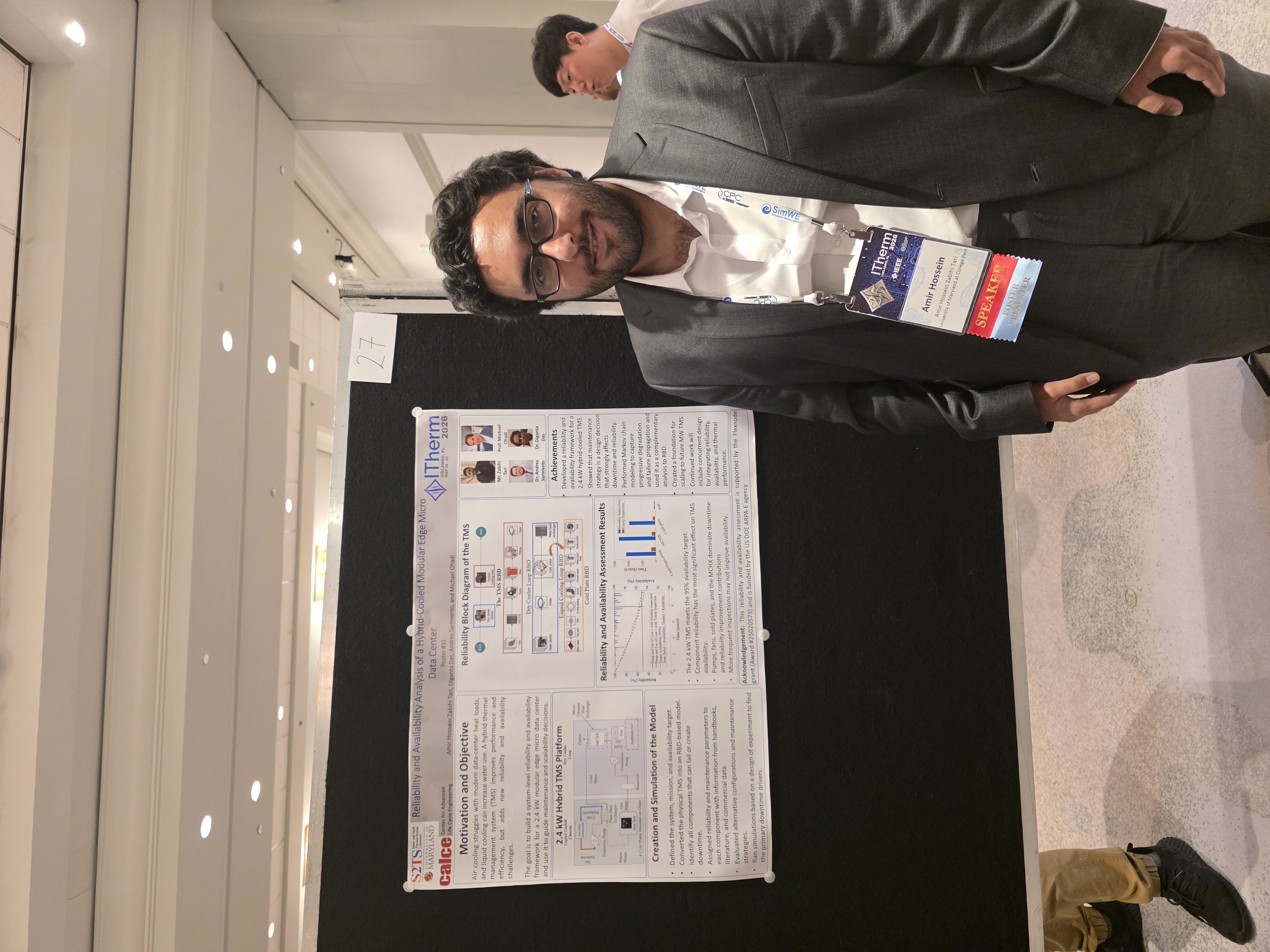
Amir Hossein Zabihi Tari, a Ph.D. student in Mechanical Engineering, presented his research titled “Reliability and Availability Analysis of a Hybrid-Cooled Modular Edge Micro Data Center” at the 25th ITherm 2026 in Orlando, Florida. The work was co-authored by Diganta Das, Andres Sarmiento, and Michael Ohadi, and conducted in collaboration between the Smart and Small Thermal Systems Laboratory (S2TS) and CALCE at the University of Maryland.
The presentation focused on the growing need to evaluate the reliability and availability of thermal management systems as data centers move toward higher power densities and increasingly adopt hybrid and liquid-cooling technologies. While hybrid cooling offers a practical path for managing high-density computing loads, it also introduces additional components, interfaces, and maintenance needs that can affect system uptime.
The study integrated component-level failure probability distributions with a system-level Reliability Block Diagram model to simulate reliability, availability, downtime, and the impact of different preventive maintenance strategies. The model incorporated reliability data from manufacturers, literature, and reliability handbooks, and evaluated key components, including pumps, fans, cold plates, hoses, fittings, filters, and microchannel heat exchangers.

The work highlighted the importance of combining reliability modeling, maintenance planning, redundancy evaluation, and degradation analysis early in the design of data center cooling systems. The framework developed for the 2.4 kW unit provides a foundation for future scaling toward high-power edge data center thermal management systems, including future work on availability-aware design methods, cost-aware maintenance decisions, spare-parts planning, redundancy, and grouped repair and replacement strategies.
This research was supported by Flexnode, Inc., the S2TS and CALCE laboratories at the University of Maryland, and funding from the U.S. Department of Energy’s ARPA-E program.
For more information about this presentation, contact Dr. Diganta Das or Prof. Michael Ohadi.
Published June 2, 2026
Recent Stories
Stories / Oct 12, 2026
Han Appointed IEEE EPS Distinguished Lecturer

Stories / Sep 4, 2026
Strain Sensors for Early Detection of Thermal Runaway in...
Stories / Sep 1, 2026
CALCE Research Featured in Batteries Editor's Choice Articles
Stories / Jul 10, 2026
MATRIX Helping Maryland Build Tomorrow's Workforce

Stories / Jul 10, 2026
2026 Counterfeit Parts and Materials Symposium at College Park
Stories / Jun 30, 2026
Publication of IEEE Std 1413-2026: IEEE Standard for Framework...
Stories / Jun 30, 2026
CALCE Research Project Highlighted by UL Research Institutes
Stories / Jun 24, 2026
Dean Graham Reappointed to Second Five-Year Term

Stories / Jun 16, 2026
Han Wins IEEE EPS Outstanding Sustained Technical Contribution...

Stories / Jun 4, 2026
Risk and Reliability in Space-Based Data Centers